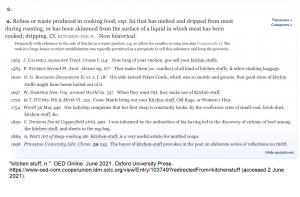
The Oxford English Dictionary Online definition.
Kitchenstuff is animal leftovers or unwanted parts: the fat of meat skimmed from a pot (like my bouillon, gathered out of the dripping pan and shaved off cuts of meat, skin or bones.1 By custom, kitchenstuff “belonged” to the household cook, to sell for their own benefit. Where there was no specialist cook, saving the kitchenstuff may still have been a routine part of the household oeconomy. In this respect Rein’s Oekonomische Abhandlungen marks a division between fat obtained from slaughter and kitchenstuff. The rendered tallow harvested in larger pieces first should be used to make lights, while “all unclean fat and tallow in the kitchen should be used for soap boiling, as good usable common laundry soap can be obtained from it.”2 Collect it, the author continues, from
bones that contain fat or marrow; the rinds from speck and ham; the scum of fatty meat, such as that which is skimmed to clean the broth; all the tallow left over from cooked pork; the impurities washed out of butter; the tallow from candles that have lost their wick. 3
How could I not experiment with saving the kitchenstuff of my household and turning it into useful fat? I decided the effort would provide another set of material experiences that might illuminate the interplay between fat in the household and in industries.
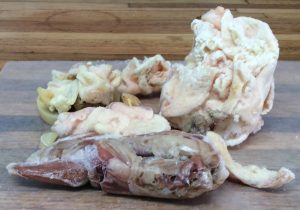
My kitchenstuff (Chicken, including skins, beef, lamb).
I don’t eat much flesh and, for a great proportion of what I purchase, the fat, bones, and skin are removed.4 The collection I assembled included the animal parts I was uninterested in eating, and those that were fatty but where collection would yield too little, or it was too difficult or too tedious to bother with. I saved what I could over about 8 months.
My first task was to chop (fine dice) the kitchenstuff, as I had tried to do with Pork Chop C. I let the frozen material thaw a bit and, having learned my lesson there, hand-chopped it. I find it easier to sharpen a cleaver than the blade on my Cuisinart. I find it easier to clean, too.
Chopping semi-frozen anything is always messy, but it seemed to me I lost less material than before. Cleanup was also easier.
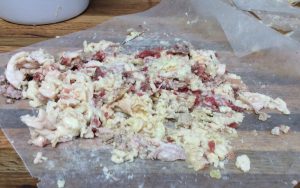
Chopped kitchenstuff.
I placed the chopped kitchenstuff into the hotpot, added a quantity of water equivalent to its weight, and turned the setting to “keep warm.” I left it for 24 hours, strained out all the liquid (including the fat), returned what was left of the kitchenstuff to the pot, introduced more liquid and left it to heat for another 24 hours. I then strained out the unmelted bits, combined the two liquids and left it to cool and so the fat would solidify.
Over the next several days, I separated fat from the jellied liquid, remelting and colling it intermittently to collect fat as much as I could. When eyeballing the liquid suggested there might be less than a half-gram of fat remaining, I discarded the liquid.
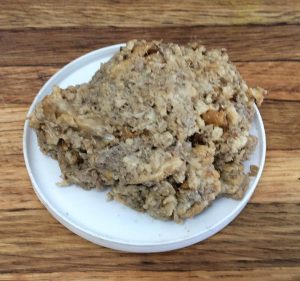
Strained out of the collection pot. I could have gone for a third strike but decided it was not worthwhile.
At right is the part that remained un-dissolved. It was mostly the bits of meat that were trimmed with the fat, some of the poultry skin, and some gristly bits.
The fat I collected (pictured below) was pale yellow-white, not quite the color of purchased lard but not as brown as the fat I’d collected in earlier trials. It had a faint beefy odor, although the largest part of my kitchenstuff by weight was probably poultry.
What to do with this fat, now? I used 20 g in a re-test of Chevreul’s saponification test described in §1049.5
The remainder awaits another good idea.
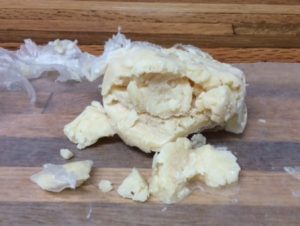
Fat harvested from kitchenstuff.
Numbers
Weight of the (frozen) kitchenstuff: 325 g
Weight of the (unfrozen) and chopped kitchenstuff added to the pot: 303 g
92% of the kitchenstuff collected
Water added: 306 ml
Time simmered before first straining: 24’ 10”
Water added, second strike: 310 ml
Time simmered between first and second straining: 24’ 0”
Fat harvested 141g
46% of the rendered kitchenstuff
The material that didn’t render 52 g
17% of the rendered kitchenstuff