Introduction
A classic bouillon slowly cooks edible and inedible animal parts, especially those harvested from cattle (beef), with aromatics—vegetables and herbs.1 The best result is a flavorful broth that solidifies when cool.
Bouillon is considered a highly nourishing substance and particularly appropriate for children, invalids, and the elderly. It is also a recommended component of many other dishes. When reduced (concentrated), it is a prized ingredient in French haute cuisine. All recipes for bouillon describe the removal of fat as critical to the process.2 What should happen to it is seldom mentioned in bouillon recipes, nor is it given material characteristics. The bouillon-maker will know this waste product . . . somehow. But how should it look, smell, taste, feel? What are its consistent qualities and how might the fat vary? How many tea lights will a vat of bouillon produce? I have made bouillon all my life but I have never paid attention to the fat.
Bouillon-Making as a Fat-Generating Exercise
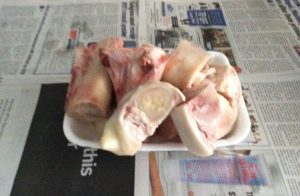
I collected several kilos of beef marrow bones, feet and some fatty-looking neck parts. I began the experiment by roasting the marrow bones and feet, about two-thirds of the total by weight. Roasting caramelizes the sugars in the meats and gives depth and color to the soup. Some fat liquifies in the process.
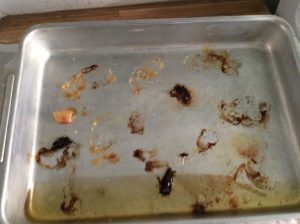
Fat (and some scrapings) in the roasting pan.
When the roasted bones were cool, I collected the liquified fat and added the bones and pan scrapings to the stock pot. There was more fat visible on the bones, and I wondered about the differences between the quickly-melted fat and the less so. It is clear that “animal fat,” even “beef fat,” is not one thing. I introduced the neck meat, cold water, carrot, onion, celery, and a bundle of herbs.
In a sense, my endeavor is the complement to the Oekonomische Abhandlungen recommendation and the whole notion of kitchenstuff.3 If uneaten or inedible fat is too valuable to throw out, so was the soup that would be the by-product of my fat collecting. I set the stock pot on a low flame and left it to simmer —murmur—for about eight hours. I then let the contents of the pot cool and refrigerated all overnight.
The next morning, I skimmed the fat from the surface, and stored it separately from the collection I’d taken from the roasting pan. I returned the stockpot pot to a low heat and after another 4 hours of simmering I removed the bones to clean them of all meat, fat, and gristle. I added all the other solids to a separate pot with cold water and set this to boil: A separate, second boiling for your bouillon is suggested by some recipe writers. This will produce a still-nourishing but decidedly more watery soup.4 Of course, I was interested to know if I could release more fat from the animal products. For the next four days I subjected the contents of this pot to intermittent periods of simmering and cooling, returning the pot to the refrigerator overnight and collecting the accumulations of fat each morning.
Once the mess factor exceeded the yield factor, I declared the data-collection portion of the experiment over.
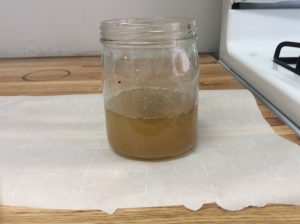
Unstrained beef fat.
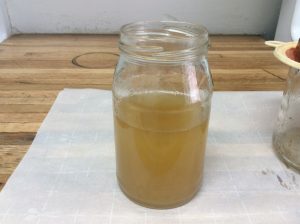
All the strained beef fat, still liquid. It looks like more than at left because the jar is narrower.
The final stage was to combine all my collections of fat and strain it to remove unwanted particles. This was not a complete rendering as these pictures show.5
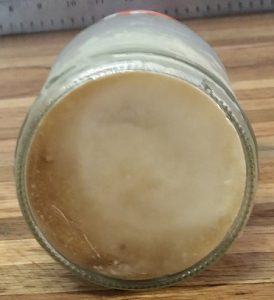
My collection of beef fat solidified (and still dirty).
Assessments
The Results:
- About 1 quart of bouillon
- Vegetables devoid of color and taste
- Meat devoid of color and taste
- Inseparable-seeming gristle and meat
- Inseparable-seeming gristle and bone
- Bone
- Fat
Numbers
- Total raw animal parts: 2.32 kg
- Weight of the cleaned bones first removed: 1.06 kg 45% of the total
- Total cleaned bones 1.20 kg 52% of the total
- Total meat, sinew, fat, gristle etc. 1.12 kg
- Undissolved material at end 0.64 kg 57% (excluding bones)
- Fat 0.48 kg 43% of liquid 21% of total
- Fat collected: 0.20 kg 41% of expected yield 18% of non-bone material 8% of raw animal parts
Observations
The fats I collected at various stages of the bouillon-making process feel different; some are very smooth and others more rubbery. I did not pay enough attention to location of the fat in the animal parts I used; this is a datapoint I might add the next time I make bouillon, or play around with animal materials.
The first collection of fat, from the roasting pan, was the easiest to obtain, least messy to collect and needed the least refining. It was a consistent pale-yellow color with only a slight odor. It felt, well, greasy.
The second collection, skimmed from the first simmering, included some of the gelled liquid and bits of bone and gristle. I had to render it before use.
The third collection produced a minimal quantity of fat.
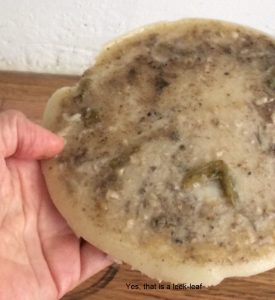
Fat removed from the stockpot. It’s melting on my fingers.
At one point in the rendering, I tried freezing the fat and then washing in cold water to remove the unwanted components. Alas, the fat had the lower melting point.
I lost or abandoned fat at every stage of the collecting processes. Some of this was due to my inexperience, but I believe that I might have lost a smaller percentage of the total if I had been working with larger quantities.